Arielle Link
PhD candidate, Integrative Biology
Faculty advisor: Monica Turner
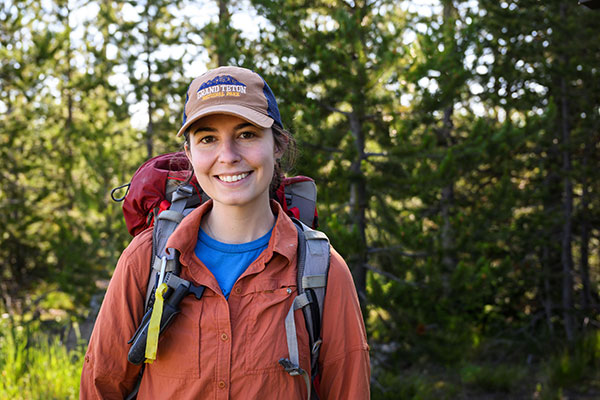
Arielle Link is a PhD student whose research focuses on nitrogen cycling and soil microbial communities in post-fire lodgepole pine forests in Grand Teton and Yellowstone National Parks.
Lodgepole pine forests in the Greater Yellowstone Ecosystem are historically resilient to fire and able to grow back after several decades to resemble how they were before the fire, Arielle said. However, as fires happen more frequently, some forests burn again before they have a chance to fully recover. The soil microbial communities Arielle studies are important for forests’ recovery after fires because they regulate nutrient cycling. One of these important nutrients is nitrogen, which trees need to grow. Since there is little nitrogen naturally available in the soil of lodgepole pine forests, trees rely on partnerships with fungi that help them access nitrogen in exchange for carbon.
“We expect more and more of these reburns to occur, making it increasingly important to monitor how these landscapes are changing and responding to repeat disturbance,” Arielle said. “This knowledge will hopefully help inform management strategies and guide efforts to protect these ecosystems in a future with more fire.”
WARF supported Arielle with an Advanced Opportunity Fellowship (AOF) in 2021. In 2023, Arielle received the National Science Foundation’s Graduate Research Fellowship (GRFP). She said the AOF support allowed her to focus on developing research questions and honing her interests during her first year of graduate school. She also appreciated the flexibility that the fellowship gave her and the connection to community events and opportunities shared with AOF scholars.
“After taking several years to work before starting graduate school, the transition to being a student and living in a new place was challenging. I was able to take more classes than if I were also teaching, one of which was a course on fungi that heavily influenced the trajectory of my dissertation,” Arielle said. “Without AOF, I might not have had the time to take several classes that helped guide my GRFP application and research questions.”